
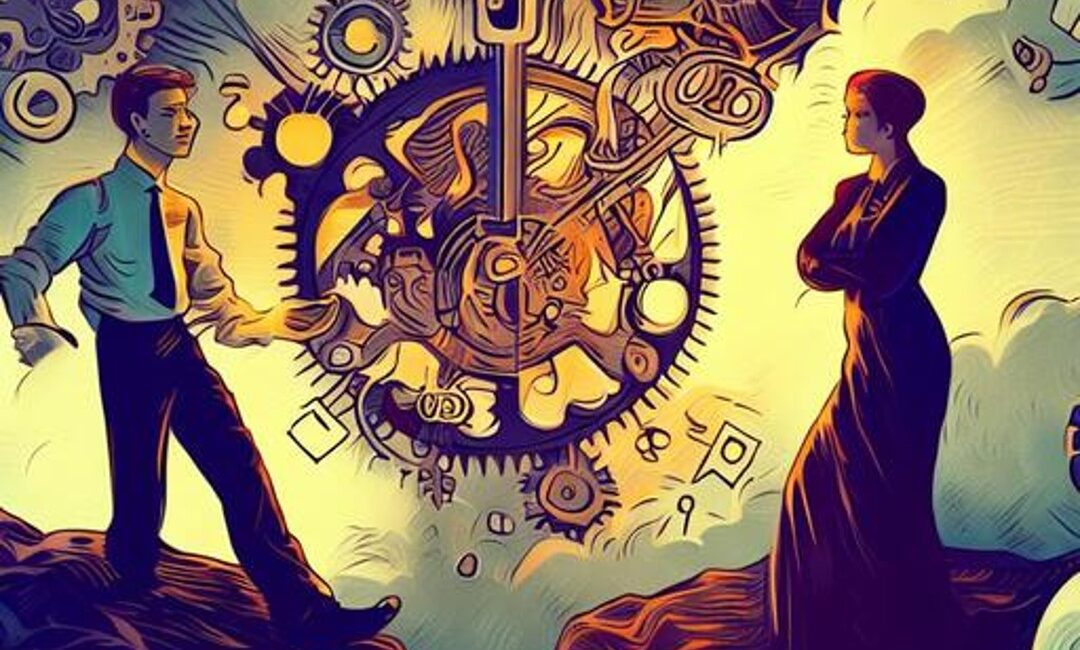
The concept of free will has intrigued philosophers, scientists, and theologians for centuries. At the heart of the debate lies the tension between determinism, the belief that every event is causally determined by preceding events, and the notion of human agency, the ability to make choices and act freely. In this essay, we explore the problem of free will, examining the compatibility of determinism and human agency, and the implications of this ongoing philosophical inquiry.
- Determinism: Cause and Effect Determinism posits that every event, including human actions, is causally determined by preceding factors. According to this perspective, the laws of nature and the initial conditions of the universe dictate all subsequent events, leaving no room for genuine freedom of choice. Determinism suggests that if we possessed complete knowledge of the present state of the universe and the laws governing it, we could predict with certainty all future events, including human actions.
- Challenges to Free Will: The compatibility of determinism and free will faces significant challenges. If determinism holds true, it appears to undermine the concept of personal responsibility, moral accountability, and the idea that individuals have the power to shape their destinies through their choices. Additionally, the existence of external influences, such as genetics, upbringing, and societal conditioning, raises questions about the extent to which individuals can exercise genuine freedom in decision-making.
- Libertarianism: Defending Free Will Libertarianism offers a perspective that defends free will and challenges determinism. Libertarians argue that human beings possess the capacity for genuine, indeterministic choice, free from the constraints of causal determinism. They propose that free will emerges from an element of randomness or unpredictability within human decision-making processes, allowing for actions that are not strictly determined by prior causes.
- Compatibilism: Harmonizing Determinism and Free Will Compatibilism seeks to reconcile determinism and free will by proposing a nuanced understanding of freedom. Compatibilists argue that freedom and determinism are not mutually exclusive. They contend that even if our actions are determined by external factors, as long as we act according to our desires, preferences, and internal motivations, we can still be considered free agents. Compatibilism suggests that freedom is not necessarily the absence of determinism but rather the ability to act in accordance with our own values and desires.
- Neuroscientific Perspectives: Advancements in neuroscience have added further complexity to the problem of free will. Neuroscientific studies indicate that brain activity precedes conscious awareness of decision-making, suggesting that our choices may be influenced by unconscious processes. Some argue that these findings challenge the traditional notion of free will. However, others maintain that the complex interplay between conscious and unconscious processes does not necessarily negate the existence of free will or human agency.
- Implications and Ethical Considerations: The problem of free will carries profound implications for various domains, including ethics, law, and personal identity. Questions regarding moral responsibility, criminal justice, and the allocation of praise and blame hinge on the assumption of free will. The resolution of the problem of free will also has implications for our understanding of personal identity and the narratives we construct about ourselves as agents in the world.
The problem of free will remains a captivating and complex topic that continues to provoke philosophical discourse. While determinism challenges the notion of free will, perspectives like libertarianism and compatibilism offer alternative ways to understand the relationship between determinism and human agency. The ongoing advancements in neuroscience further contribute to our understanding of decision-making processes. Ultimately, the compatibility of determinism and free will poses profound implications for our sense of self, moral responsibility, and the way we navigate the complexities of human existence. As this age-old debate persists, it invites us to question our assumptions about personal agency and the intricacies of our decision-making processes in an ever-changing world.